Unlicensed Casinos: Why Should You Be Careful?

Unlicensed casinos are becoming a more common topic among players. Some are attracted by lighter identity verification, others by greater privacy or more generous bonuses. At first glance, these platforms may seem appealing, but they also come with significant risks.
This makes it important to understand what an unlicensed casino actually is, why these platforms can be risky, and how to recognize a website that may not be safe to use.
Table of content
Key Takeaways
- No official regulatory oversight
- Limited protection in payout disputes
- Game fairness may not be independently tested
- Large bonuses may hide restrictive terms
- Responsible gambling tools may be missing
What Does an Unlicensed Casino Actually Mean?
The term unlicensed casino may sound straightforward, but in practice it is often confused with other types of gambling websites. Before going any further, it is important to clarify exactly what we mean in this guide.
Here, an unlicensed casino refers to an operator that holds no gambling licence whatsoever and is not supervised by any regulatory authority. This is different from a casino that operates under a licence issued in another jurisdiction. Even if a licence is not issued in your country, the operator is still accountable to a recognised regulator and must comply with its licensing requirements.
An unlicensed casino has no such oversight. As a result, players face significantly greater risks. There is no guarantee that game fairness is independently tested, no clear dispute resolution process, and no assurance that withdrawals will actually be paid.
In this guide, we focus on the highest-risk category: gambling platforms that operate without any recognised gambling regulator or licence.
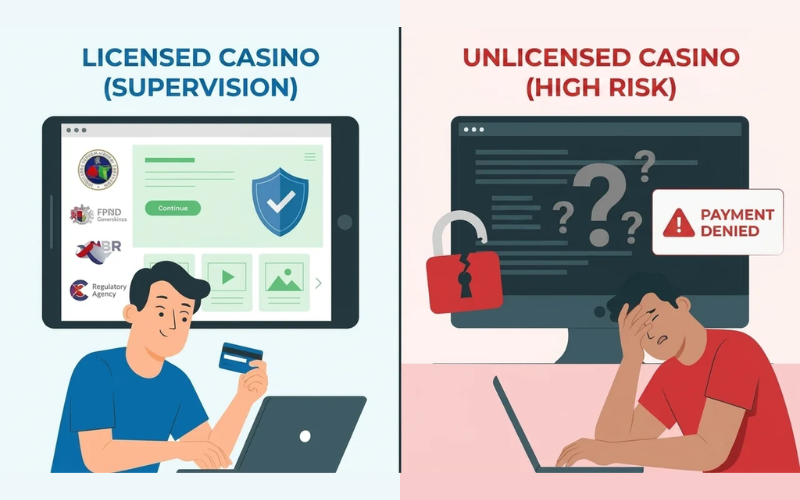
This distinction is often misunderstood. Some players assume that if a casino is not licensed in their own country, it must automatically be unlicensed. In reality, these are two very different situations.
Why do Players Look for Unlicensed Online Casinos?
Every player has their own reasons, but these sites are usually attractive because they offer fewer restrictions. In regulated markets, online casino operators must follow strict requirements, which some players see as unnecessary limitations.
Unlicensed casinos often present themselves as an alternative with fewer rules or no restrictions at all. Players who visit these sites usually expect:
- a wider selection of slots and live casino games;
- access to games that are unavailable in regulated markets;
- larger welcome bonuses, free spins, or cashback offers;
- faster registration without lengthy document or identity checks;
- cryptocurrency payments and quicker withdrawals;
- higher betting, deposit, and winning limits.
However, there is an important contradiction. What initially appears to be an advantage is often a direct result of the lack of oversight. Fewer checks may offer more freedom, but they also mean less protection if the platform delays a withdrawal, changes its terms, or simply ignores a complaint.
Main Risks of Playing at Online Casinos Without a License
The biggest risk is simple: when no authority supervises the online casino, players are often left on their own if a dispute arises. For example, if the site delays a withdrawal, blocks an account, or suddenly changes its bonus terms, the player can usually only deal with the operator directly.
The table below compares the main differences between licensed and unlicensed casinos.
| Licensed casino | Unlicensed casino | |
|---|---|---|
Player protection | Clear rules and regulatory oversight | Depends entirely on the operator |
Dispute resolution | Players can contact the relevant regulator | Customer support is usually the only option |
Game auditing | Games are checked by independent auditors | Audits may be unclear or completely absent |
Data security | Legal requirements must be followed | Security standards may be unclear |
| Responsible gambling | Protective tools are mandatory | These tools are often unavailable |
Fraud and Dishonest Operators
When no authority supervises a casino, dishonest operators can avoid responsibility more easily. These sites may delay withdrawals, repeatedly request new documents, or refer to unclear terms when a player tries to cash out winnings.
In the worst-case scenario, the casino may disappear completely and later return under a different name. In such cases, proving ownership of the funds or recovering the money can become extremely difficult.
Lack of Player Protection
Licensed operators must have a clear complaints procedure. Unlicensed casinos have no such obligation, which means players are often left without support when something goes wrong.
Regulatory authorities also highlight this risk. They warn that players who use illegal online gambling sites may lose their deposited funds and cannot rely on local institutions to protect their rights or interests in the event of a dispute. In other words, there is almost no safety net.
Data Security and Privacy
Casinos process sensitive information, including personal details, payment information, and copies of identity documents. Licensed operators must comply with data protection laws, including the GDPR in the European Union.
Unlicensed websites may ignore these requirements. This means your information may be stored improperly, protected inadequately, or, in the worst case, shared with third parties.
Game Fairness
Reliable casinos use tested random number generators, while independent testing companies such as eCOGRA and iTech Labs audit their games. This provides at least a basic level of confidence that game results are fair.
Unlicensed casinos often lack this type of testing. When a site provides no information about audits, certificates, or software providers, it is difficult to assess whether its games operate fairly. This does not mean that every unlicensed casino is fraudulent, but the risk is considerably higher.
Game Selection and Bonuses at Unlicensed Casinos
Unlicensed casinos often attract players with extensive game libraries and large casino bonuses. However, the number of games or a high bonus percentage alone does not show whether a platform is trustworthy.
What Should You Check When Reviewing the Games?
When assessing a casino’s game selection, look beyond the total number of titles. It is also important to check who supplies the games, whether they are independently tested, and what RTP figures are shown.
- Slots may look appealing, but some of them would not be available at all in regulated markets.
- For live dealer games, check whether they come from established studios.
- Crash games move very quickly, which makes them particularly high risk.
- The same game may have a different RTP on different websites, such as 96% at one casino and only 94% at another.
If the platform does not clearly state who supplies the games, whether they are tested, or what RTP applies, this is a serious warning sign. The website may look attractive, but its reliability can be very difficult to assess.
Why Can Bonuses Be Misleading?
Unlicensed casinos often offer larger bonuses than regulated platforms. However, the key issue is not the size of the bonus but its terms: whether they are clear, realistic, and whether any winnings can actually be withdrawn.
Before claiming any offer, always check the wagering requirements, expiry date, maximum bet rules, and any cap on winnings. At regulated casinos, these terms are usually presented more clearly. On unlicensed websites, they may be hidden in the small print or written in a way that pressures players into making a quick decision.
For this reason, a high bonus percentage or hundreds of free spins do not automatically make an offer worthwhile. Some promotions appear generous at first, but in practice, using the bonus or withdrawing the winnings may be extremely difficult.
How to Tell Whether a Casino Is Unlicensed
Even when a website looks professional at first glance, a few simple checks can quickly reveal how risky it may be. Focus less on promotional claims and more on how clearly the operator provides information about its ownership, licence, games, and player protection measures.
Before registering, check:
- whether the website names the operating company, owner, and country of registration;
- whether it provides a licence number that can be verified on the regulator’s website;
- whether the game providers are clearly listed, rather than only the game titles;
- whether the website uses SSL encryption and clearly explains payment processing times;
- whether responsible gambling tools are available, such as limits, self-exclusion, and account history;
- whether the operator responds publicly to complaints and takes meaningful steps to resolve them.
If you cannot find clear information about the owner, licence, or regulatory oversight, and the website instead focuses on promises of risk-free winnings, the casino should be approached with extreme caution.
Responsible Gambling and Where to Get Help
Fast deposits and limited verification checks can make it harder to control spending, so a responsible gambling is especially important. Gambling should remain a form of entertainment, not a way to make money.
To prevent gambling from becoming a problem, follow a few basic principles:
- Only gamble with money you can afford to lose.
- Set time and spending limits before you start.
- Do not try to recover losses by increasing your bets.
- Take a break if you feel stressed, angry, or tempted to gamble more than planned.
If gambling starts to cause financial or emotional difficulties, stop playing and seek help from organizations like GamCare or GambleAware as soon as possible.
FAQ About Unlicensed Casinos
Is it legal to play at an unlicensed casino?
These websites are considered illegal, so their domains and payment transactions may be blocked. Players are usually not punished directly, but they do not receive protection from national authorities if a dispute occurs.
Do unlicensed casinos pay out winnings?
Some unlicensed casinos do pay winnings, but there are no guarantees. The main risk is that there is no regulatory authority to help if a payout dispute arises.
How can you identify an unlicensed casino?
First, look for a licence number, company details, and information about the game providers. If this information is missing and the website promises risk-free winnings, the operator should be treated with extreme caution.
Why do bonuses at unlicensed casinos look larger?
Operators without regulatory oversight have more freedom when creating their offers. However, high bonus percentages often come with strict wagering requirements, short validity periods, or limits on winnings.
What should you do if a casino refuses to pay winnings?
Save all correspondence, payment records, and account information. If the casino has no licence, there may be very few practical ways to force the operator to pay, so it is best to avoid these situations in the first place.
Is it safe to use cryptocurrency at an unlicensed casino?
Cryptocurrency payments can be fast, but they involve additional risks. If the casino disappears or refuses to pay, the transaction cannot be reversed because there is no bank or payment provider that can step in.

 English
  Български
  Deutsch
  Français
  Italiano
  Magyar
  Português
  Русский
  Română
  Slovenský
  Svenska
  Türkçe
  Українська